
Hummingbird: external appearance, ageing, sexing
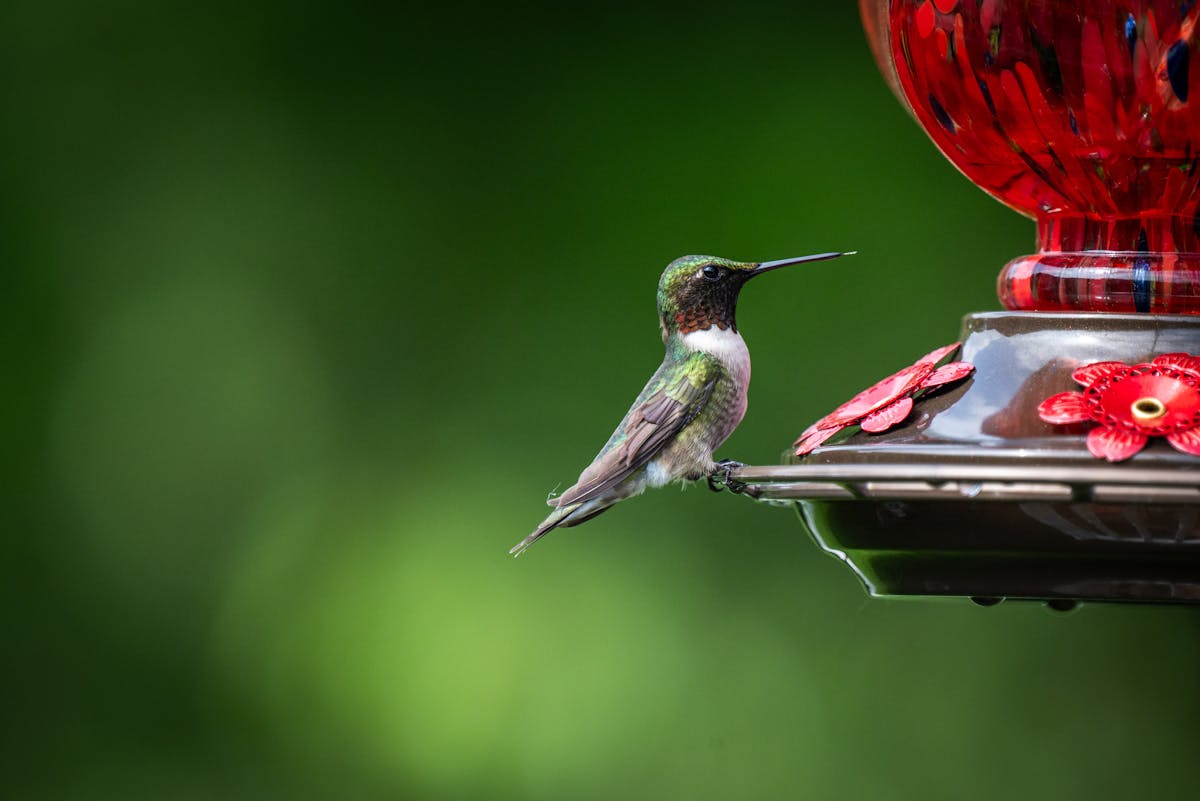
Male vs Female Ruby Throated Hummingbird
Ruby-throated Hummingbirds fly quickly and straight. They can stop on a dime, hover, and move up, down, or backward with great control. They often visit hummingbird feeders and floral tubes. Here, they protect their food from other hummingbirds. You may even see them pick tiny insects from the air or spider webs.
Adult Ruby-throated Hummingbirds, Archilochus colubris, show sexual dimorphism. The males and females look very different from each other. Young males “dress” as females until their first winter, when they acquire adult male plumage. This can make aging and sexing problematic during summer and fall following fledging of young of the year. From May through October, don’t take for granted that all the white-throated hummers at your feeders are females, as many of them will be young males.
Here are the RTHU external features and tips for distinguishing sex age classes.
RELATIVE SIZE IN RUBY-THROATED HUMMINGBIRDS
The Ruby-throated Hummingbird measures about 3 inches (7.5 centimeters) long when resting. Its bill makes up roughly 1/5 of that length. Unlike most animals, in RTHUs, the adult females are usually on average about 15-25% LARGER than the adult males. (There are still “big” males and “small” females, however, so ruby-throat cannot be sexed by size.)
Baby Hummingbirds? All hummingbirds are full-grown and able to fly, when they leave the nest – there would be no “baby hummingbirds” visiting your feeders or flowers. In other words, baby hummingbirds are flightless. It’s a Hummingbird Moth, a small creature that is hovering at a flower or feeder.
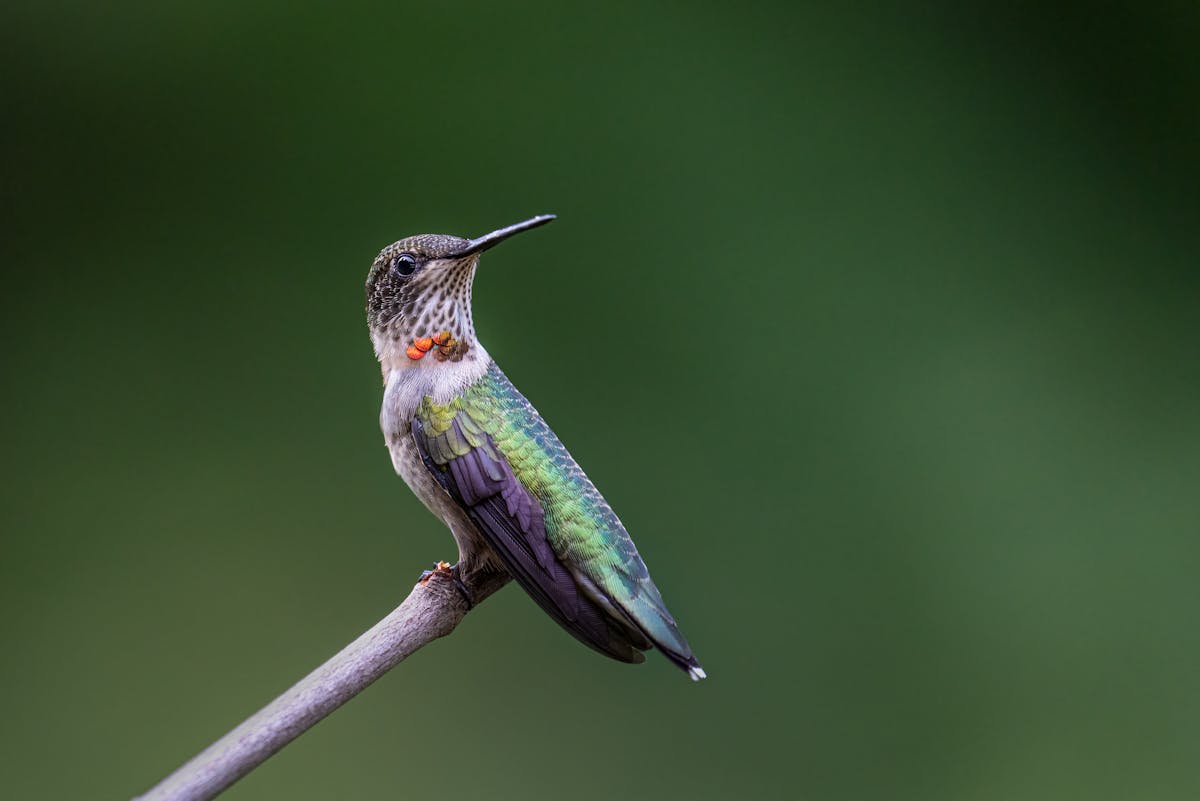
The bird in the photo above right is an immature male RTHU with a partially red gorget. (See next section for plumage details.)
Canopy photo by Arlete A. Cavalari—Courtesy Intervet. All text and photos © Hilton Pond Center. This Week at Hilton Pond. Copyright Info. Just CLICK a logo below.
PLUMAGE
All average Ruby-throated Hummingbirds have shiny green backs. Sometimes, they can appear dull or bright. For the most part, adult males are darker than females and young males. Keep in mind that the colors of the hummingbird are structural and will differ depending on the amount and angle of light. In dim light, the Ruby-throated Hummingbird appears almost black instead of green or red.
ADULT MALE
Throat: metallic ruby-red (can be golden or bronze).
Back: metallic green or bronze-green.
Wings: near-black.
Tail feathers: pointed, whole, near-black (no white tips).
Tail: forked.
Breast and belly: mostly brownish-gray.
Flanks: metallic bronze-green.
Crown: metallic dark green.
Whitish area below gorget may give the appearance of forming a light ring around bird’s neck. The adult male is gray-breasted with a dark tail and a red gorget. He often looks much darker than females or younger males, especially in dim light.
Female:
Throat: white, sometimes with rare pale buff streaks. Occasionally, an old female may have one or two black or red feathers.
- Back: bright metallic green or bronze green.
- Wings: plain near-black.
- Tail: rounded, fan-shaped, with outer three feathers tipped white.
- Belly and vent: white.
- Flanks: light brown.
- Crown: metallic dark green.
Young: Similar to females, but young males usually show dark streaking (green or black, sometimes buff) on their throats. Later in summer, they often develop one or more red throat feathers. (Almost all the birds that show obviously streaked throats are young males; see photos below.) Young of either sex can show brownish fringes to an otherwise green body plumage—especially on crown and back (above). Young males can have white throats, too. So, you can only age white-throated Ruby-throated Hummingbirds at a feeder in SPRING. This is before the young birds have fledged!
ADULT MALES
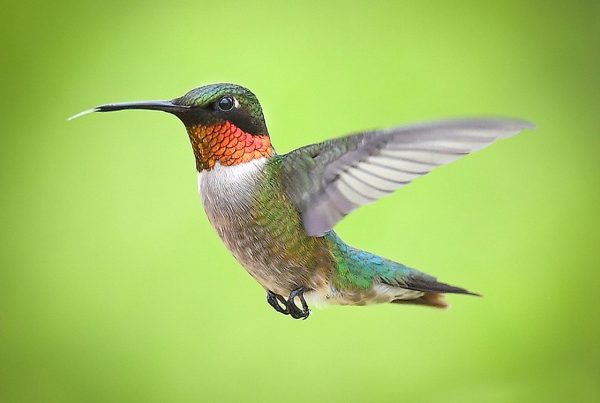
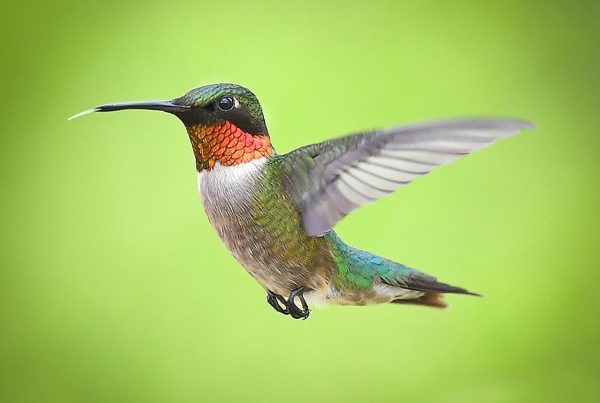
Over time, males’ gorget red increases. The black sting appears on the beak, and the ruby throat reaches the beak’s corner. Finally, the gorget becomes fully red, as shown in the top picture (ADULT male). Only adult male Ruby-throated Hummingbirds have the bright red gorget. From the side, this red gorget might not look as bright, like in the bottom picture above.
 ADULT & JUVENILE FEMALES
Hi Judy, all female Ruby-throated Hummingbirds have a white throat. Some show soft gray or buffy streaks, as seen in the two photos above. Some older females have one or two black throat feathers [below]; very extremely rarely, the entire face is surrounded by a ring of red feathers. Young males (see later section) and females are indistinguishable.
JUVENILE MALES (also see above)
A young male Ruby-throat might have a white throat like a female. It can be streaked with black or green, creating a “five o’clock shadow” effect.” The bird above it is the most streaked we have observed; the one above is more typical.
YOUNG MALES: Young males MAY show one to several red throat feathers by late summer, but no fully red gorget until the following winter. When he returns the next spring, some researchers believe a young male may have a gorget that’s frayed at the bottom. It might also show one or more long throat feathers that are black instead of red. This could be a useful aging clue, but more research is needed.
All young male Ruby-throated Hummingbirds get a full red gorget in their tropical winter homes. When they return to the U.S. and Canada in spring, they look like any other adult male hummingbird. Very rarely, some birds that stay in the U.S. during winter instead of going to Mexico or Central America show “arrested development.” These birds keep their dark throat streaking until late spring and then quickly develop their full red gorget.
Adult male Ruby-throated Hummingbirds (above left) are blackish and short-tailed. They have all-dark tail feathers with no white tips, and their tail is forked. Young males (above right) have white tips on the outer three tail feathers, just like females of any age. Each feather is rounded, giving the tail a fan-shaped look. The similar looks of female and young male hummingbirds make it tough to tell them apart at feeders in early summer after the young hatch. But in the spring, any bird with white on the tips of its tail is an adult female.
The Ruby-throated Hummingbird has a bill that is black bill. It can look dull or shiny. Sometimes, it may appear slightly whitish or yellowish due to pollen. The bill of young birds is etched with fine lines known as “corrugations” (above), which either fill in and/or wear down from the tip. This creates a smooth surface after 6-8 months. However, adult birds may show some corrugations near where the bill meets the head. The corrugations (so small that most people need a magnifier to view) are often only apparent on birds-in-the-hand. In the second photo above, the bird’s bill tip shows some smoothing. This means it has 80% corrugations. It’s a young bird, late in its first summer. The gape, or corner of the mouth, is yellow in fledglings, like in many bird species. In adults, it can be ivory, white, or pinkish-white.
The eye of the Ruby-throated Hummingbird is blackish, but seen in the hand the iris is a dark brown and the pupil is black. In both sexes, there is a small area of white feathers behind each eye.
In some species of birds, the mud is a characteristic of the juvenile’s iris. This does not appear to be true in hummingbirds and cannot, therefore, be employed to Age a bird.
The bird in the opening photo is an immature female (again Catharina) color-marked with some green dye on her upper breast/lower throat. See Color-marking.
When a wing of a Ruby-throated Hummingbird is stilled against the bird’s flank, it takes on a curve and point. The tip of the wing is also typically far beyond the point where the body meets the tail and often extends beyond the tip of the tail. In the air the wing is a tall right triangle. One way to identify North American hummingbirds is by looking at their wing length compared to their body.
In the hand, a good look at the tip of the #6 primary was enough to confirm the sex of even a young RTHU. Males always have tapered, sharp-tipped #6 primaries (below left and bottom), while #6 in females is rounded (below right).
The only regularly breeding hummingbird east of the Mississippi is Ruby-throated Hummingbird (Archilochus colubris), so for most eastern birders, it’s mouthful, and that makes it THE HUMMINGBIRD. However differentiating between males and females — and adults from juvenile — are where people struggle more than is expected. They are real, and you can see the differences with a good look. Here’s what to look for, specifically.
The Basic Size Difference
Unlike most bird species, female Ruby-throated Hummingbirds are larger than males — by about fifteen to twenty-five percent, on average. Wingspan and body mass are higher in adult females. Nevertheless, these size overlaps — large males, small females — make it difficult for size to sex a bird consistently. Treat it as an indicator, not a decider.
The entire body measures 3 0.5 to 3.75 inches with the bill accounting for about one-fifth of this length.
The Male: What to look for
Adult men are the simple ones. It is characterized by a ruby-red iridescent throat patch, the gorget. But it’s not always red. Iridescent plumage is all in light angle. Gorgets appear totally black when viewed from the right angle. It glows bright red-orange or deep crimson at the appropriate angle. While in-flight, as the male turns, the gorget appears to change color from one moment to the next.
The gorget is not what it appears to be in males: a black solid chin directly below the gorget, and bright emerald-green upperparts (crown, back, rump) with whitish-gray underparts with greenish wash on the sides. Adult’s tail forked, outer tail feathers slender and pointed. The tail fork is faint but noticeable in the bird when it holds its tail fanned out while hovering.
Female: Male potatoes, how to tell them apart
The upperparts of both sexes are bright emerald-green, including adult females. In this case, the bottom is your clue — e.g., females have white underparts (with buffy or grayish wash on the sides) and, most importantly, a plain white throat with no gorget. In some instances, there is just a faint dusky streaking on the throat region.
Her tail is a little different from the male’s: rounded, not forked; wing tips on the three outermost tail feathers on either side are white. You see these white tail corners when the bird hovers and they are arguably the best field mark for separating female-plumaged birds.
The Complication: Immature Males
This is where things get confusing with identification. First-year males resemble adult females, with white throat, rounded tail with white corners and green upperparts. They grow into adult male plumage in their first winter, but as fledglings during the summer and autumn, for casual observers they appear identical with females.
During late summer at an average backyard feeder, many of the suspected “females” are juvenile males. The takeaway: from late summer through early fall, often assume you’re watching young males loosely accompanying adult females and a plain white throat isn’t really to be used as the final word on sex.
Immature males at least begin to show some red or dark gorget feathers by late August or September. A white throat but with a dark or ruby red center cluster is the clincher that the bird is an immature male.
Behavior Differences
Male adults come to the breeding grounds earlier than females — usually one or two weeks early in spring — and quickly occupy territories. Both males and females chase all other hummingbirds at feeders and in areas with flowers. Only adult males perform a diving courtship display in which steep U-shaped arcs are traced over a perched female while producing a sharp wing buzz at the bottom of each arc.
The male does NO nest building, incubation, or chick-rearing. Male has no role in breeding overall. Because the female is doing all the provisioning, females are often more consistently observed at feeders during this period.
Plumage Quick Reference
| Characteristics | Adult male | Adult female | Immature male |
|---|---|---|---|
| Throat | Ruby-red gorget | Simple white | Mainly white; may show some dark/red feathers |
| Shape of the tail | Split tail | Round tail | Round tip |
| End of tail | None (dark) | White tips | White tips |
| Upperparts | Greenish emerald | Emerald green | Emerald green |
| Underparts | — | White-gray | Greenish sides; gray feathers on back with white tips and black dots (fur-like appearance) |
| Arrival timing | Early spring | Late | — |
When “Baby Hummingbirds” Aren’t
A misconception that definitely deserves some addressing: No baby hummingbirds are at feeders. Hummingbirds brim with life in the nest, inhabiting their full size long before they fledge — they do not dwindle as they mature. It’s a little old hummingbird at your feeder: just a small adult. Unlike other nestlings, true nestlings are flightless and never leave the core of their nests until they’re more or less fully-grown.
If you spot something hovering at your feeder that is smaller than a hummingbird, this insect buzzing around will much less likely be an underage hummer — another frequent misidentification but far more common in the late summer when hawk moths are highly active.
Migration Timing
Most people are surprised to learn that Ruby-throated Hummingbirds depart their breeding grounds at much earlier dates than most folks would have guessed. In parts of the range, adult males start leaving as early as late July. Followed by females and young, through August or September. Most others have long vacated the eastern US by mid-October, en route to wintering areas in Central America and southern Mexico.
It has been shown that the folk belief to take down feeders in fall to force hummingbirds south is incorrect. Late-lingering adults tend to be birds that would stick around for a tighter pre-migratory assemblage of local birds, and not local birds held back by food availability. Leaving feeders into October helps fuel late migrants.

MD Imdadul Haque is the founder of BirdzFly, a research-backed resource on North American backyard birds. Drawing on years of independent study into bird identification, behavior, and migration patterns, he writes in-depth guides designed to help US birders understand the species in their own backyards — from common feeder visitors to seasonal migrants passing through.