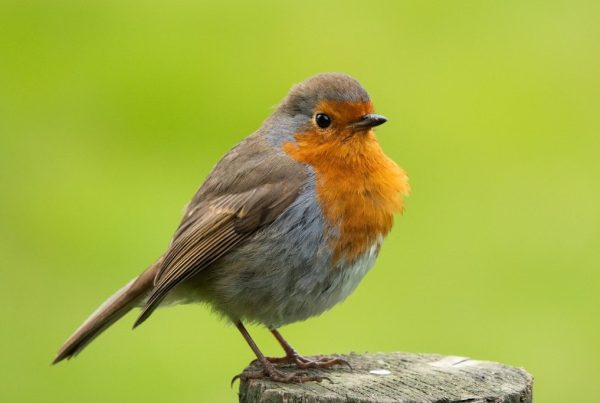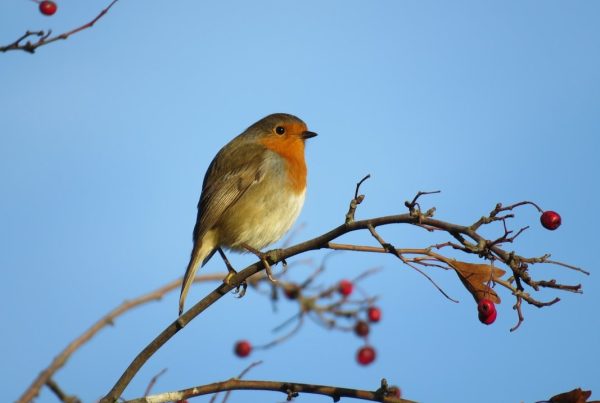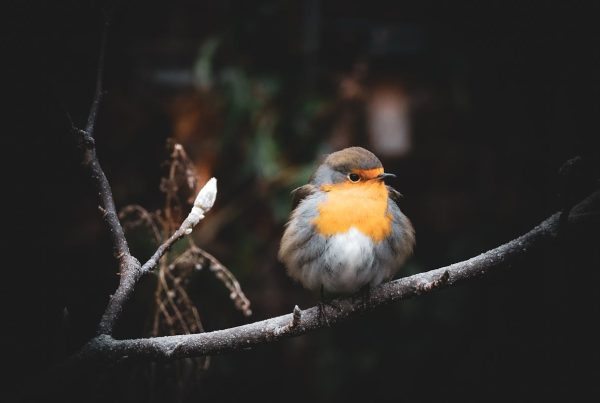

The American Robin is the most abundant bird in North America. Estimates put the total population at around 370 million individuals. It’s familiar to almost everyone — that orange-red breast, the territorial song starting before dawn in spring, the posture of a robin cocking its head on a lawn while it listens for earthworms. It’s one of those birds that people stop noticing because it’s always there.
That familiarity is worth looking past. The robin does some genuinely interesting things.
Identification
Adult male: Dark gray-brown back, black head, orange-red breast and belly, yellow bill, white markings around the eye, white lower belly. The breast color ranges from pale orange to rich brick-red depending on the individual.
Adult female: Similar to male but head is gray-brown rather than black, breast color paler. The difference is subtle — many people assume all robins are the same.
Juvenile: Spotted breast — no solid orange-red. The spots disappear during the first summer molt. A spotted-breast robin is always a young bird.
Size: About 10 inches long, wingspan 12–16 inches. One of the larger North American songbirds — noticeably bigger than a sparrow or finch.
Basic Facts
| Feature | Detail |
|---|---|
| Scientific name | Turdus migratorius |
| Family | Turdidae (thrushes) |
| Length | 9–11 inches |
| Weight | 2.7–3.0 oz |
| Wingspan | 12–16 inches |
| Lifespan | 2 years average; up to 14 years on record |
| Eggs per clutch | 3–5, turquoise blue |
| Incubation | 12–14 days |
| Broods per year | 2–3 |
| Conservation status | Least concern |
Diet
The robin’s diet shifts significantly by season. In spring and summer, earthworms make up the majority — sometimes 40% of daily food intake. Robins locate worms by sight, not sound, despite the popular belief that they’re “listening” with their tilted heads. The head tilt positions one eye to look at the ground surface for movement.
In fall and winter, when frozen or hardened ground makes earthworms inaccessible, robins switch almost entirely to fruit: crabapple, hawthorn, holly, winterberry, juniper, dogwood. They become nomadic, following berry crops in loose flocks rather than holding individual territories.
Throughout the year, robins also eat beetles, grasshoppers, caterpillars, and other invertebrates. During nesting season, insects provide the protein that developing chicks need.
Behavior and Migration
American Robins are partial migrants. Northern Canadian populations move south substantially in winter. Many mid-range US birds stay in approximately the same area year-round but shift from open habitat to forested berry patches — which is why they seem to disappear in winter even when they’re still nearby.
In spring, males arrive on breeding territories 2–3 weeks before females and immediately begin singing to establish territory. The robin’s song — a rolling series of phrases, often described as “cheerily, cheer up, cheer up, cheerily” — is one of the first sounds of spring across most of North America and starts before dawn.
In fall and winter, robins form large communal roosts. Flocks of hundreds or thousands of birds sometimes gather in areas with abundant berries. These roosts are rarely noticed by people who only look for robins on lawns.
Nesting
The female builds the nest alone over about a week. The nest is a mud cup — coarse grass and plant material on the outside, a layer of wet mud pressed and shaped with her body and bill, fine dry grass lining the inside. The dried mud makes it unusually sturdy; intact robin nests hold their shape for months after abandonment.
Common nest locations: forks of deciduous trees 5–25 feet up, dense shrubs, building ledges, porch lights, gutters, security cameras, and any outdoor bracket providing a stable surface with overhead cover. Robins readily nest on human structures and are not secretive about placement.
Clutch: 3–5 turquoise-blue eggs. Incubation 12–14 days. Chicks fledge at 13–15 days old — before they can fly well — and spend 2–3 more weeks on the ground being fed by parents.
What Is the American Robin Best Known For?
Three things, mostly:
The sign of spring. Robins are deeply associated with spring’s arrival across North America, which is partly accurate (males singing in February do signal the season turning) and partly myth (many robins were there all winter, just invisible).
The earthworm hunt. The image of a robin on a lawn, tilting its head, pulling a worm from the ground is among the most recognizable bird behaviors in North America. It’s a functional, efficient behavior — robins locate worms by detecting movement at the soil surface.
The turquoise eggs. Robin’s egg blue has become a standard color name because the eggs are that specific, vivid shade and nothing else quite matches it among common North American birds.
Spiritual and Cultural Significance
In folk tradition, robins are associated with renewal, messages from deceased loved ones, and the presence of hope in difficult times. The red breast appears in Christian legend (stained by Christ’s blood at the crucifixion), in Celtic tradition (associated with the Otherworld and threshold crossings), and in Native American traditions (connected to dawn and the end of hardship). See our complete guide on robin symbolism and spiritual meaning.
Conservation
The American Robin is one of the most abundant birds in North America and has a stable to slightly increasing population. It scores low on conservation concern scales.
The main threats are pesticide exposure (robins forage on lawns where pesticides are commonly applied), window strikes, and cat predation. Robins are protected under the Migratory Bird Treaty Act — it is illegal to harm them, their eggs, or their nests.
FAQ: American Robin
What does an American Robin look like?
Dark gray-brown back, black head (males) or gray-brown head (females), orange-red breast and belly, yellow bill. Juveniles have spotted breasts rather than solid orange-red.
What do American Robins eat?
Earthworms and insects in spring and summer. Fruit — crabapple, hawthorn, holly, winterberry — in fall and winter.
Do American Robins migrate?
Partially. Northern populations move south in winter. Many mid-range birds stay year-round but shift to forested berry habitat. See our full guide on whether robins migrate.
Why do robins tilt their heads?
To position one eye to look at the soil surface for movement. They find earthworms by sight, not sound.
How many broods do robins raise per year?
Two to three. The first clutch starts in March or April; the last may finish as late as July or August in northern states.
For more detail on specific topics, see our complete guides on American robin eggs and nests, baby robin growth stages, where robins go in winter, why robin eggs are blue, robin song and what it sounds like, whether robins actually migrate, and robin symbolism and spiritual meaning.

MD Imdadul Haque is the founder of BirdzFly, a research-backed resource on North American backyard birds. Drawing on years of independent study into bird identification, behavior, and migration patterns, he writes in-depth guides designed to help US birders understand the species in their own backyards — from common feeder visitors to seasonal migrants passing through.