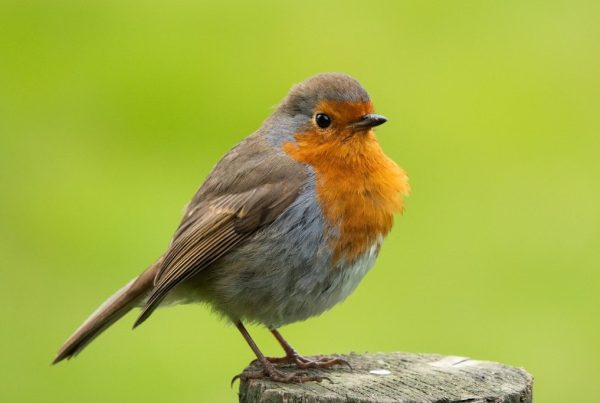
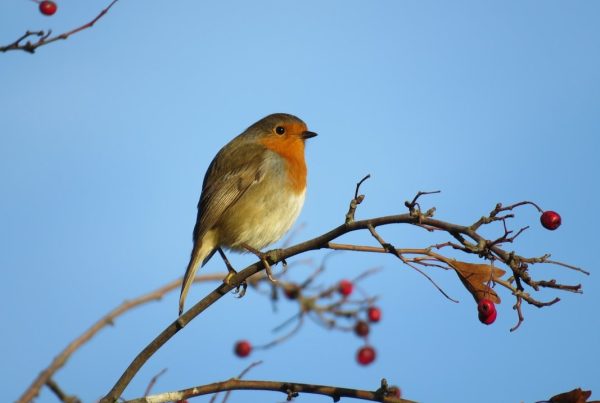
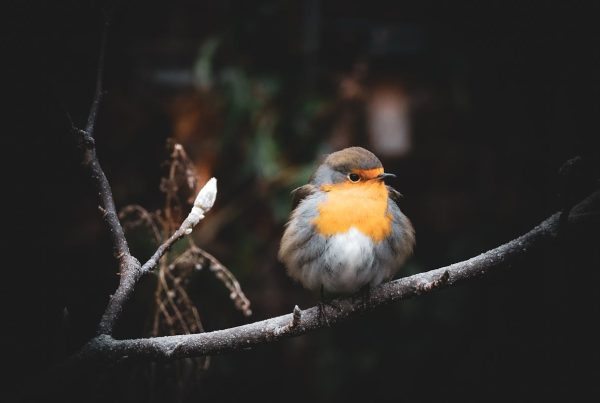
A reddish-orange breast and a gray back are not unique to the American Robin — at least seven other North American species share that same general color pattern, and several genuinely get mistaken for robins every spring. Here is how to tell each one apart, with the specific field mark that actually resolves the confusion.
1. Varied Thrush
The closest relative on this list — Varied Thrush is in the same thrush family as the American Robin, which is exactly why the confusion happens. The orange breast and gray back look similar at a glance, but the Varied Thrush has a distinctive black band across the breast and a black eye-stripe that the American Robin lacks entirely. Varied Thrush also tends to stay higher in the tree canopy, while robins are far more comfortable foraging in the open on lawns. Range is mostly the Pacific Northwest, so an “orange robin-like bird” seen east of the Rockies is very unlikely to be this species.
2. Orchard Oriole
Smaller than a robin, with a noticeably different bill shape — slim and pointed rather than the robin’s straight, slightly stouter bill. The male Orchard Oriole has a chestnut-orange breast with a black head and back, which can read as “robin-colored” from a distance. The reliable separator: Orioles visit fruit and nectar feeders readily; robins almost never do. If the bird is working a hummingbird feeder or an orange half, it’s an oriole.
3. Spotted Towhee / Eastern Towhee
Both Towhee species have rufous-orange flanks and a dark head and back — robin-like at a glance, especially when partially hidden in brush. The giveaway is the eye: Towhees have bright red eyes, which robins never have. If you can get a clear look at the eye color, this one resolves instantly.
4. Black-headed Grosbeak
A western species — found mostly in the American West, where it regularly gets confused with robins by people used to seeing American Robins back east. The Black-headed Grosbeak has a black head, white wing spots, and a reddish throat band, set against black upperparts. The heavy, conical bill (built for cracking seeds) is noticeably different from the robin’s straighter, thinner bill.
5. Hermit Thrush
Another close thrush-family relative. The Hermit Thrush lacks the robin’s orange-red breast entirely — its breast is white with dark spotting, more reminiscent of a young robin than an adult. The face and eye-ring shape are similar enough to cause hesitation, but the missing orange coloration is the fastest way to rule out an adult robin.
6. Red-breasted Nuthatch
The name alone causes most of the confusion, but the resemblance mostly ends there. Red-breasted Nuthatches are tiny — significantly smaller than a robin — with a gray back, black eye-stripe, and a much shorter tail. Nuthatches also move distinctively: they climb tree trunks and branches, often upside down, a behavior robins never display.
7. American Redstart
A warbler, not a thrush, and considerably smaller than a robin. The male American Redstart has a black head and back with orange patches on the wings, tail, and sides — orange rather than the robin’s solid red-orange breast block. The behavioral tell: Redstarts constantly fan and flash their tail while foraging, a habit robins don’t share.
Quick Reference Table
| Species | Key Field Mark | Range |
|---|---|---|
| Varied Thrush | Black breast band, black eye-stripe | Pacific Northwest |
| Orchard Oriole | Visits fruit/nectar feeders | Eastern/Central US |
| Spotted/Eastern Towhee | Bright red eyes | Nationwide (range-split) |
| Black-headed Grosbeak | Heavy conical bill, white wing spots | Western US |
| Hermit Thrush | White spotted breast, no orange | Nationwide (seasonal) |
| Red-breasted Nuthatch | Climbs trunks upside down | Nationwide |
| American Redstart | Constant tail-fanning | Eastern US (migratory) |
FAQ: Birds That Look Like Robins
What bird is most often mistaken for an American Robin?
The Varied Thrush, because it’s in the same family and shares the basic orange-breast, gray-back color pattern. The black breast band is the fastest way to confirm a Varied Thrush rather than a robin.
What small bird looks like a baby robin?
The Hermit Thrush is frequently mistaken for a young robin — its spotted white breast resembles a juvenile robin’s spotted plumage, even though Hermit Thrush adults always have that spotted pattern.
How can I tell a Towhee from a robin quickly?
Check the eyes. Towhees have bright red eyes; robins do not. This single field mark resolves the confusion faster than any plumage comparison.
For more on robins specifically, see our guides on American Robin identification and robin symbolism.

MD Imdadul Haque is the founder of BirdzFly, a research-backed resource on North American backyard birds. Drawing on years of independent study into bird identification, behavior, and migration patterns, he writes in-depth guides designed to help US birders understand the species in their own backyards — from common feeder visitors to seasonal migrants passing through.